
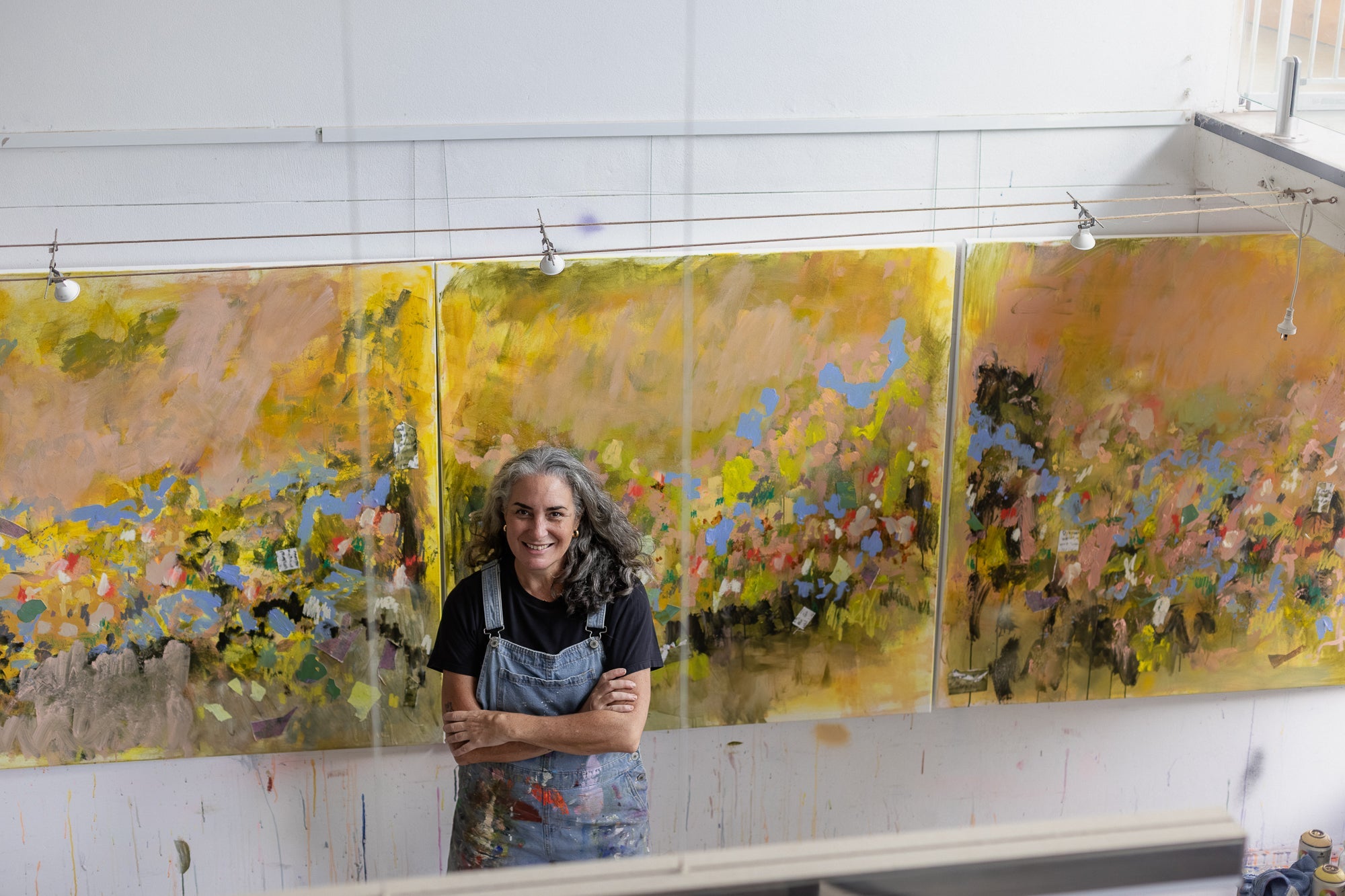
Participating in Twenty-Six Seconds has deepened my ongoing inquiry into the parallels between the human body and the Earth's body—two living, sensing systems shaped by time, memory, and transformation.
As both an artist and sonographer, I’ve long been interested in how we “read” the invisible, and how traces, pulses, and rhythms can be made visible through tools like those used for medical imaging. In this project, we extended that approach beyond the human body and into the landscape surrounding Eramboo, using sonography, X-rays and sound to capture the terrain’s quieter moments. These signals—fleeting, often imperceptible—became the starting point for visual responses rooted in pigment, pressure, and intuition.

This process directly informed my recent series Field Notes from the Body of the Earth. In these paintings, conceived as a triptych, I approach the land as if it were a body under examination—its surface a site of layered information, abrasion, and repair. Each canvas is treated as a palimpsest: a surface that carries the residue of touch, time, and atmospheric change. I’m interested in how we record the world—not just through scientific means, but also through the language of gesture, material, and emotion.

The act of painting becomes a way of listening to and tuning into the subtle signals that rise from below the surface. There is both vulnerability and strength in what is revealed.
Through Twenty-Six Seconds, I was reminded that collaboration—especially across disciplines—can open new ways of seeing. When artists, scientists, musicians, and thinkers come together, we begin to trace connections that are not immediately visible. We start to map the unseen.
And maybe, through this mapping, we can begin to understand our place in a world that is constantly shifting, both within us and around us.

